Knife Master: Challenge Game
- 4.9
- Rating
- 10.00K
- Installs
- Free
- Price

 Analysis by App-foxy
I spent time with Knife Master: Challenge Game as a quick arcade title built around a very clear idea: throw knives, break wooden logs, and work toward boss encounters. That simplicity is its strongest quality. I could understand the basic objective almost immediately, yet the timing required more attention than the bright, uncomplicated presentation first suggests.
Developed by Blastproof Games, this is a free game for Android in the arcade category. It carries an Everyone age rating, so its cartoon-like action is approachable for a broad audience. The current version is 2.0.22, and the game runs on Android 7.1 or later. Those details make it easy to place: this is not trying to be a large role-playing adventure or a deep simulation, but a focused pick-up-and-play challenge for short sessions.
The store page shows a 4.9 average from around 170 ratings and more than ten thousand installs. I would not treat that rating alone as proof that everybody will enjoy it, but it does match my general impression: the central action is easy to grasp, responsive enough to make repeated attempts feel worthwhile, and suited to people who like arcade games that ask for concentration rather than a long tutorial.
You May Also Like

 AccuWeather: Weather Radar
AccuWeather Review: A Quick, Clear Forecast for Everyday Decisions
For everyday plans, the best forecast is the one you can understand quickly. AccuWeather makes rain timing, radar, and local conditions easy to act on, with a few trade-offs.

 Hill Climb Racing
Why Hill Climb Racing Still Turns Crashes Into One More Run
A tiny car, a bumpy hill and one more upgrade: Hill Climb Racing keeps resurfacing because its simple chaos makes every near-miss feel personal.

 AliExpress - Shopping App
AliExpress Makes Global Shopping Feel Personal, but Shoppers Bear the Risk
AliExpress turns a global marketplace into a pocket-sized discovery engine. Its reach is useful, its shopping loop compelling, and its trade-offs easy to miss.

 Lords Mobile: Kingdom Wars
Lords Mobile Is a Kingdom-Building Routine, Not a Quick Match
A case-by-case verdict on the building, battles, device demands, and social commitments that make Lords Mobile rewarding for some players and exhausting for others.

 PDF Scanner app - TapScanner
TapScanner Makes Paperwork Easier to Capture, Check, and Share
TapScanner makes scanning with a phone feel less like a rescue operation and more like a dependable step in getting work done. Its capture tools are useful, though not flawless.

 Block Blast!
 Shows How Much a Puzzle Game Can Leave Out
A quiet grid game shows why puzzle players increasingly value instant clarity, repeatable skill and low-pressure play—and where the genre still needs to catch up.
More From Our News Desk
View All News


How the goals and pacing shape each session
I find the pacing most useful when I treat a session as a small practice window rather than a test of endurance: I can focus on one decision, notice what made a throw unsafe, and stop before repetition turns dull. That also makes the game easier to share, because another person can take a turn without needing a long explanation. The next question is how to keep those handoffs comfortable on a shared device.
The first goals are clear, but the real test is timing
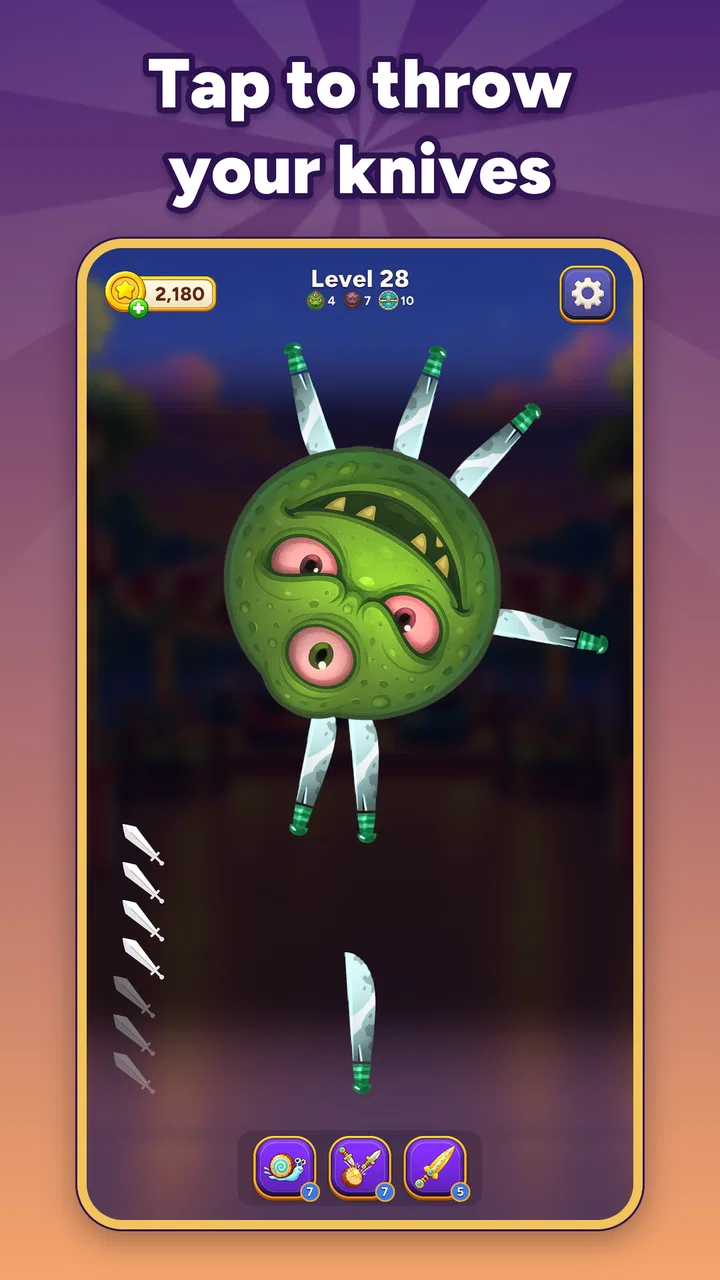
The opening objective is refreshingly direct. I am not asked to learn a complicated menu system or manage a large collection of resources before playing. The immediate task is to place knives into a rotating log without colliding with knives already stuck there. Breaking through the log gives the session a visible purpose, while the promise of bosses gives the short-term action a larger target.
That structure works because each throw has two jobs. It advances the current log, but it also teaches me how to read the available gaps. A careless throw can make the remaining space awkward, so simply tapping quickly is not always the best approach. I found myself switching between patience and decisiveness: wait when the opening is narrow, then act before the rotation turns the opportunity away.
A useful habit is to stop thinking of every gap as equally safe. The widest opening may not remain wide for long, and a throw that looks comfortable can become risky if I release without watching the rotation. I had better results when I watched one complete movement before committing, especially after a failed attempt had already made me overconfident.
This is one of the game’s more effective early lessons. It does not need a long explanation to communicate that accuracy matters. The log itself becomes the instruction, and the knives already placed in it become warnings about how much room is left.
Progress feels visible even when the mechanics stay small
The game’s progress signals come from the changing condition of the target and the arrival of tougher encounters. I can see whether I am close to completing a log, and I can feel the pressure increase when the available placement space becomes less forgiving. That is enough to create a modest but understandable rhythm: begin carefully, build confidence, then deal with the consequences of earlier throws.
The boss idea is especially important because it prevents the game from feeling like an endless series of identical targets. Even when the core action remains the same, a boss encounter gives the next stretch of play a reason. I was more willing to retry a failed attempt when I had a clear sense that success would move me toward a more important challenge rather than merely add another routine round.
At the same time, players should keep their expectations realistic. This is an arcade loop, not a story-driven progression system. The satisfaction comes from improving execution and reaching the next challenge, not from exploring a large world or building a character over many hours. If you need elaborate unlock trees, equipment decisions, or narrative rewards to maintain interest, the compact structure may feel too narrow.
For me, the strongest progress signal is personal rather than numerical: I begin to recognize when I am rushing, when I am misreading the rotation, and when I should preserve a safer opening. That makes each retry useful. I am not only hoping for better luck; I am adjusting a specific part of my play.
Why the difficulty curve can hold attention
The challenge comes from the relationship between timing and limited space. Early throws can feel generous because the log has room, but every successful placement changes the next decision. The more knives I add, the less freedom I have. This creates a natural curve without requiring a complicated control scheme.
That curve is also where the game can frustrate. A mistake near the end of a log feels more painful than a mistake at the start because I have already invested attention in the attempt. I consider that fair for an arcade game, but it means the title is better suited to players who can accept repetition. Someone looking for a relaxing game with almost no failure pressure may find the later throws tense rather than soothing.
My practical advice is to treat each attempt as a short exercise in restraint. Do not throw simply because a button is available. Watch the rotation, identify the safest opening, and avoid letting a previous successful throw convince you that the next one requires the same timing. The position of the existing knives changes the problem, so repeating the same tap rhythm is rarely a reliable strategy.
Another useful approach is to separate progress from speed. Finishing a log quickly may feel satisfying, but a slower sequence with cleaner decisions is usually more valuable when the target becomes crowded. That trade-off gives the simple mechanic some depth: the game rewards control, not just activity.
Bosses add pressure without changing the identity of the game
Bosses are the clearest promise that the game has a destination beyond ordinary log breaking. They help organize the arcade loop into meaningful stretches and make the player care about surviving a few more throws. I liked that the boss goal supports the existing mechanic instead of distracting from it. The game remains about knife placement, timing, and avoiding collisions.
However, the boss structure should not be mistaken for a completely different mode. The appeal is still built on the same compact action. If you enjoy arcade games because a familiar rule becomes harder under pressure, this is a good fit. If you expect boss fights with elaborate patterns, multiple abilities, or a separate combat system, you may find the encounters more modest than the word “boss” suggests.
That distinction matters when deciding whether to install it. I would recommend it to somebody who wants a focused challenge that can be understood in seconds and practiced over repeated attempts. I would skip it for a player whose priority is exploration, character customization, or a long-form campaign.
What keeps the loop going, and where it may lose momentum
The retention pressure comes mainly from unfinished attempts and the desire to correct a mistake. When I fail after placing several knives, the next attempt starts with a clear question: can I handle that same situation more calmly? This is a stronger reason to replay than a vague promise of “more content,” because the obstacle is immediately understandable.
The loop is also convenient in everyday use. I can imagine playing while waiting for a coffee, during a short commute, or between tasks when I want something more engaging than scrolling. A session does not require me to remember a complex plot or rebuild a strategy from a previous day. I can open the game, read the rotation, and start making decisions.
That convenience has a downside. Because the core interaction is so concentrated, longer sessions may become repetitive if I am not personally motivated by mastery. The game has to rely on the pleasure of better timing and the pull of upcoming challenges. Players who need frequent mechanical variety may reach their limit sooner than players who enjoy polishing one skill.
I also would not choose this as a background game for multitasking. The controls may be simple, but the timing is not something I can handle well while dividing my attention. A notification, conversation, or rushed tap can spoil an otherwise good attempt. It works best when I give it a minute or two of genuine focus rather than treating it as something to play without looking.
How it compares with familiar arcade alternatives
Compared with endless runners, this game is less about reacting to a continuously changing path and more about making deliberate placements around one target. That makes it feel calmer at the beginning, but the pressure rises sharply as safe space disappears. Players who prefer lane switching and constant movement may find the stationary format too restrained.
Compared with match-based puzzle games, it offers fewer layers of planning and no need to search a board for combinations. Its appeal is more immediate: observe, time, throw, and learn from the result. I prefer this when I have only a short break and do not want to reconstruct a complicated board state.
It also differs from action games that give the player several attacks or defensive options. Here, the limited action set makes mistakes easier to understand. If I fail, I can usually point to a bad release or poor reading of the available gap rather than wondering whether I selected the wrong ability. That clarity is a genuine strength, although it also means the game cannot hide repetition behind a large toolbox.
In other words, this is a good alternative when you want an arcade challenge with a single strong idea. It is not the better choice for someone seeking variety first. The right comparison is not “which game has more features?” but “do I want to master a tight timing loop or constantly discover new systems?”
Practical fit for different players
For a casual player, the low barrier to entry is a major advantage. The objective is understandable without specialist knowledge, and the Everyone rating makes it suitable for a wide audience. I could hand it to a friend who rarely plays games and explain the basic goal in a few words.
For a more competitive arcade player, the value depends on how much satisfaction comes from refining timing. The game gives that kind of player a clean target: reduce careless throws, read the rotation earlier, and reach the boss challenges more consistently. It is less suitable for somebody who measures progress mainly through deep builds, extensive collections, or complex strategic choices.
For families, the straightforward presentation is approachable, but I would still expect younger players to need practice with patience. The action looks simple, yet the most important lesson is not to tap immediately. That makes it a reasonable game for learning controlled reactions, provided the player enjoys retrying after mistakes.
For phone owners with older devices, the minimum requirement of Android 7.1 or later is reassuringly broad. I would still judge the experience on the particular device, especially if the screen is small or touch input is inconsistent, because a precise arcade game is less forgiving of accidental taps than a turn-based title.
My verdict on the progression
Knife Master: Challenge Game succeeds when it keeps the focus on small improvements. Its early goals are clear, its logs provide immediate visual feedback, and its bosses give the repeated attempts a destination. I never needed a complicated explanation to understand what I was trying to improve: my timing, my patience, and my ability to manage shrinking space.
The trade-off is equally clear. The progression is compact, and the game’s long-term appeal depends heavily on whether you enjoy repeating a focused action. It does not replace a full arcade collection, a puzzle campaign, or a character-based adventure. Those alternatives are better when variety, story, or customization matters more than precision.
Because it is free, the barrier to trying it is low. I would recommend it to anyone who likes short arcade sessions and wants a challenge that becomes harder through positioning rather than complicated controls. I would especially suggest playing with full attention for a few minutes instead of judging it from the first easy throws. The later pressure is where the timing loop shows its character.
My final impression is positive but specific: this is a focused knife-throwing arcade game that earns retries by making mistakes readable. It does not need to be bigger to be enjoyable. As long as you are comfortable with repetition and want to chase cleaner decisions, Knife Master: Challenge Game is an easy free game to keep around for brief, skill-based breaks.
FAQs for Knife Master: Challenge Game
01What is Knife Master: Challenge Game?
Knife Master: Challenge Game is a casual reflex game centered on throwing knives at rotating targets. The main objective is to aim carefully, tap at the right moment, and hit the target without striking knives that are already embedded in it. As the stages progress, targets usually become faster, smaller, or more difficult to predict, making timing and concentration increasingly important.
02How do you play Knife Master: Challenge Game?
Gameplay is generally simple to understand: watch the target’s movement, tap the screen to launch a knife, and try to place each knife in an available section. You must avoid collisions with previously thrown knives and other obstacles that may appear during later challenges. Although the controls are easy, successful progress depends on patience, accurate timing, and learning the rhythm of each level.
03Is Knife Master: Challenge Game suitable for children?
The game’s controls and arcade-style mechanics are easy for many children to learn, but parents should still check the age rating and the specific content shown on the store page before downloading it. Knife Master is presented as a fictional skill challenge rather than a realistic simulation, although advertisements, competitive elements, or optional purchases may also be included depending on the version.
04Does Knife Master: Challenge Game require an internet connection?
The basic gameplay of a reflex-based knife-throwing game may work without a constant internet connection, which can make it convenient for short sessions while traveling or when mobile data is unavailable. However, online access may still be needed for advertisements, analytics, updates, cloud features, leaderboards, or in-app purchases. Check the current store listing and test the installed version for exact offline support.
05Are there advertisements or in-app purchases in Knife Master: Challenge Game?
Many free casual games use advertising to support development, and Knife Master: Challenge Game may show ads between attempts, levels, or reward opportunities. Some versions can also offer optional purchases, such as removing advertisements, unlocking bonuses, or obtaining additional resources. These purchases are normally not required to understand the core mechanics, but users should review the store information and device purchase settings before playing.
Pros
- Simple controls make it easy to start playing immediately.
- Short rounds are ideal for quick breaks or casual sessions.
- Increasing difficulty keeps the challenge engaging over time.
- Accurate timing creates satisfying moments of skill and progress.
- Lightweight gameplay is suitable for a wide range of mobile devices.
Cons
- Repetitive mechanics may become dull after extended play.
- Mistimed throws can feel frustrating
- especially on harder levels.
- Progress may depend heavily on repeated attempts and memorization.
- Frequent ads can interrupt the flow in the free version.
- Limited gameplay variety may reduce long-term replay value.

Knife Master: Challenge Game
Gallery